
Our earlier overview of the Cyber Security and Resilience Bill covered what it changes and who it affects. This post is the follow-up: a practical checklist sorted by urgency. If you are responsible for compliance in an in-scope organisation, you should be able to read this, hand it to your board, and start ticking items off.
Are You in Scope?
The Bill amends the NIS Regulations 2018 rather than replacing them. It keeps existing categories and adds new ones. Work through the table below.
| Entity type | Threshold / condition | Status | Key action |
|---|---|---|---|
| Operator of Essential Services (OES) | Energy, transport, water, health, digital infrastructure — already designated | Already in scope | Review posture against tightened obligations |
| Relevant Digital Service Provider (RDSP) | Online marketplace, cloud, search engine — already designated | Already in scope | Add direct customer notification to incident response |
| Data centre operator | Colocation: rated IT load >= 1MW. Enterprise-only: >= 10MW | Newly in scope | Map NIS boundary; begin CAF assessment |
| Managed Service Provider (MSP) | Medium and large providers with privileged access to client systems | Newly in scope | Audit client contracts; expect cascade obligations |
| Large load controller | Aggregate control of >= 300MW of smart electricity load | Newly in scope | Contact energy sector competent authority early |
| Designated Critical Supplier (DCS) | Supplier to OES/RDSP whose disruption could cause significant impact — designated by regulators | Watch | Review dependency relationships with regulated customers |
| General commercial organisation | Not directly in scope unless designated as DCS | Not in scope\* | Expect contractual pressure from regulated customers |
Interactive Compliance Explorer
We have built an interactive tool to help you navigate the Bill. Select your organisation type to see which obligations apply under NIS 2018 and the CSR Bill, compare them side by side, and find your regulator.
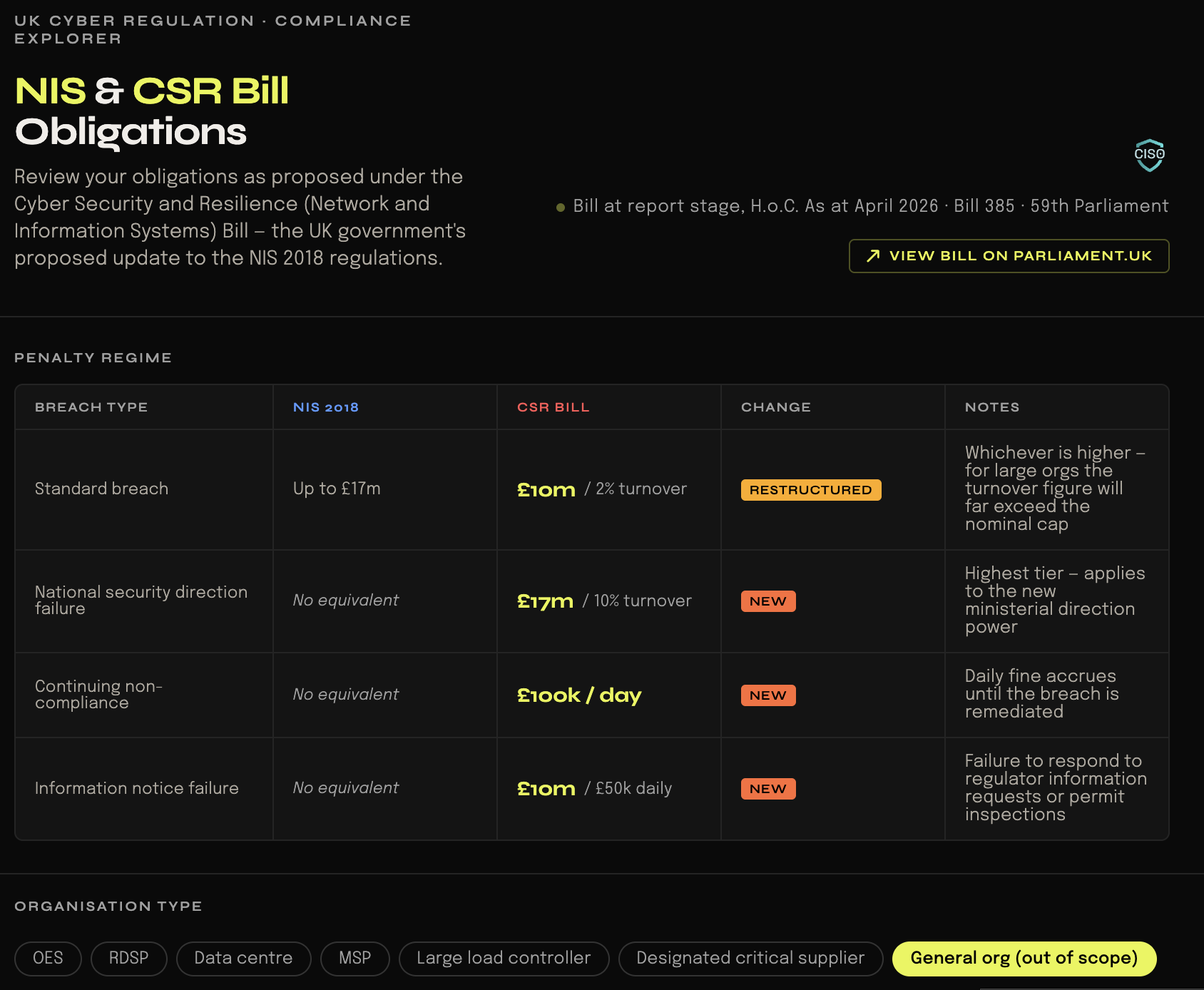
Open the UK Cyber Compliance Explorer →
Parliamentary Timeline
Know the windows when preparation becomes expensive.
| Milestone | Status |
|---|---|
| July 2024 | Announced in King's Speech |
| April 2025 | Policy statement published — scope, thresholds, and penalties confirmed |
| November 2025 | First reading — Bill introduced to Commons |
| January 2026 | Second reading and Cyber Action Plan published |
| January–February 2026 | Committee stage — line-by-line scrutiny |
| Spring/Summer 2026 | Report stage and third reading — remaining Commons stages, then House of Lords |
| Late 2026 (estimated) | Royal Assent — becomes law |
| 2027 onwards | Secondary legislation and codes of practice — Secretary of State expands scope and introduces technical requirements |
NIS 2018 entities are expected to face new duties immediately on commencement, so it would pay not to wait for Royal Assent. Newly in-scope entities should treat preparation as urgent now — incident response uplift and CAF alignment will take months to embed, not weeks.
The Checklist
NOW
These are actions that in-scope organisations should be taking today.
Governance
Incident reporting
PRE-ACT
These are actions to take before commencement, when you still have time to implement without regulatory pressure.
Supply chain
Regulatory engagement
ONGOING
These are habits and processes that should persist long after the Bill becomes law.
What the Regulators Will Look For
The Bill gives regulators proactive powers — they can request information and conduct inspections without waiting for an incident. A new cost-recovery mechanism means enforcement activity can be funded by the organisations being investigated.
What this means in practice: compliance is not just about having policies. It is about being able to demonstrate, on demand, that your controls are operational and effective. A well-documented CAF self-assessment, an incident response playbook that has been exercised, and supplier contracts with teeth will matter more than a policy binder that nobody has opened.
What Happens If You Do Nothing
The penalty structure is severe enough that inaction is a board-level risk decision, not an operational oversight.
For a mid-market organisation with £100 million global turnover, a standard breach could trigger a £2 million fine. A national security direction failure could trigger £10 million. These figures are turnover-linked, so they scale with organisational size. There is no ceiling that provides comfort to a large enterprise.
The Bottom Line
The Bill is not a one-time compliance event. The Secretary of State can expand scope, introduce new technical requirements, and issue national security directions without returning to Parliament. Your compliance posture needs to be living documentation, not a project with an end date.
Start with the NOW items. They are the foundation everything else builds on.