
Most AI governance programmes fail for the same reason: they are written by compliance teams and ignored by the people actually using the tools. The result is a policy document that sits in SharePoint while employees paste customer data into unapproved LLMs, developers wire AI agents directly into production systems, and nobody can say with certainty where company data is ending up.
If you are a CISO, this is not a governance problem. It is a control problem. And it is your control problem, because when an AI-generated decision goes wrong, a data breach originates from an AI tool, or a regulator asks for evidence of AI risk management, the policy document will not protect you.
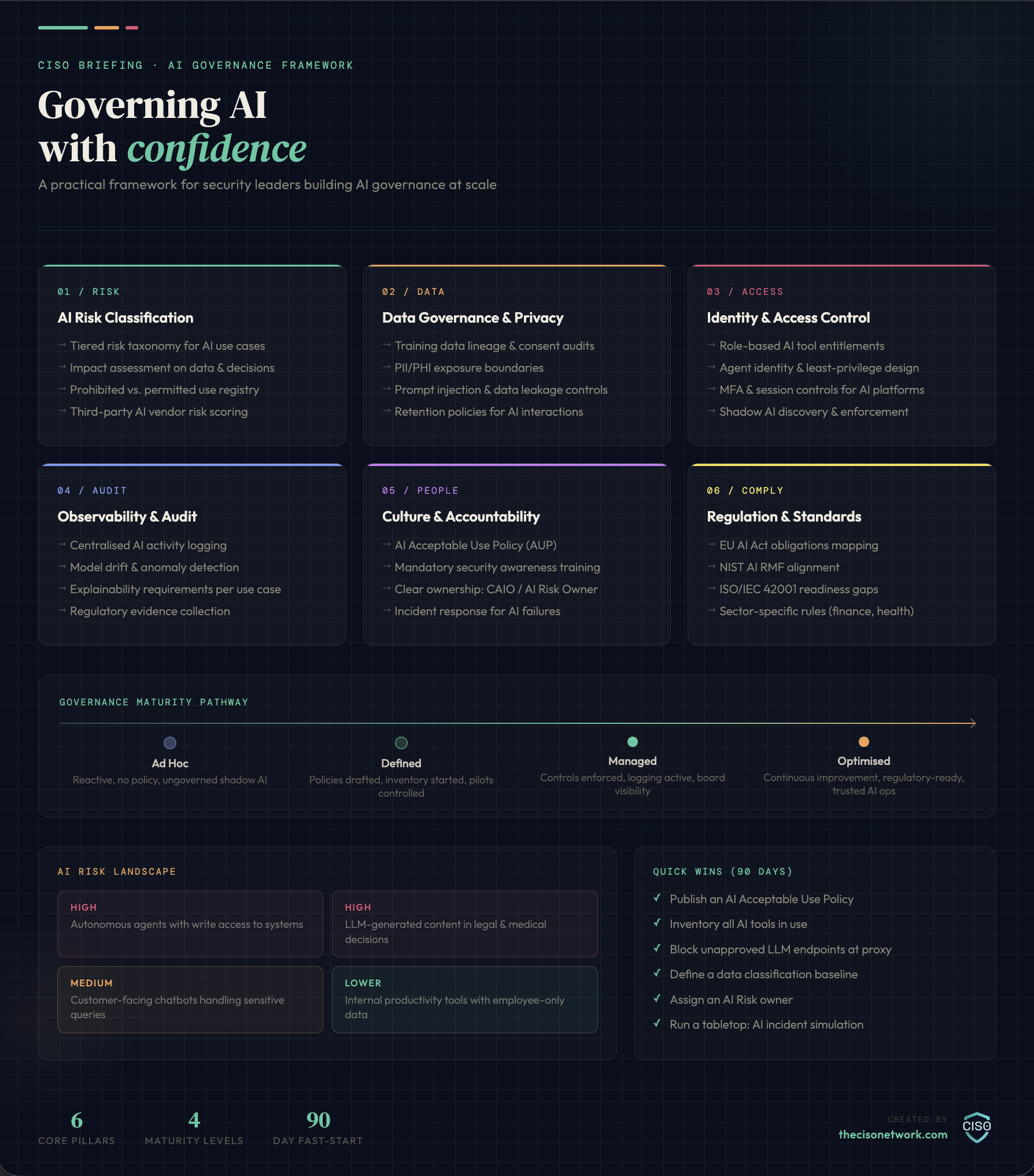
Six-pillar AI governance framework with maturity pathway and quick wins.
This article translates high-level AI governance into specific, actionable controls across six pillars. It is built from work we have done with organisations moving from ad hoc AI use to managed, auditable, and eventually optimised AI operations. The goal is not perfect governance on day one. The goal is to know where you are, block the worst risks immediately, and build operational maturity over 90 days.
Know Where You Are on the Maturity Curve
Before you write a single policy or deploy a technical control, you need an honest assessment of your current state. Most organisations fall into one of four maturity levels:
| Level | Characteristics | Typical Evidence |
|---|---|---|
| Ad Hoc | No policy, no inventory, no visibility | Employees using ChatGPT with corporate data; no one can name the AI tools in use |
| Defined | Policies drafted, inventory started, pilots controlled | An AI use policy exists but is not enforced; approved tool list covers 60% of actual usage |
| Managed | Controls enforced, logging active, board visibility | All AI traffic routes through approved gateways; monthly AI risk reports to leadership |
| Optimised | Continuous improvement, regulatory-ready, trusted AI ops | Automated risk scoring; red-teaming programme; AI incidents treated like security incidents |
Be honest. If you are at Ad Hoc, which describes roughly 60% of organisations, your first job is not to build a perfect framework. It is to stop the bleeding: discover what AI tools are in use, block the highest-risk ones, and establish basic data boundaries. That's significant progress, everything else can and will come after.
If you are at Defined, your challenge is enforcement. You probably have good documents and a partial inventory. The gap is between what the policy says and what actually happens when a developer wants to use a new AI coding assistant or a marketing team experiments with image generation.
Pillar 01: AI Risk Classification
Not all AI use is equally dangerous. A marketing team using an approved LLM to rewrite email subject lines carries different risk from an AI agent with write access to your CRM, which carries different risk again from AI-generated medical or legal advice. Your first operational task is to classify use cases by tier.
Build a Tiered Risk Taxonomy
Use three tiers at minimum. Complexity kills adoption, so keep it simple:
Create a Prohibited vs. Permitted Use Registry
This is a living document, not a one-time exercise. It should be accessible to every employee and referenced in your Acceptable Use Policy. For each permitted use case, define:
Score Third-Party AI Vendors
Most organisations use AI through vendors rather than building models themselves. Each vendor should receive a basic risk score based on:
A practical shortcut: require the same due diligence for AI vendors that you require for any other critical SaaS supplier, with one addition - a specific review of how they handle model inputs and whether those inputs are used for training.
Pillar 02: Data Governance and Privacy
Data is where AI governance becomes concrete. An AI tool without data is just an interface. The risk emerges when sensitive data flows into models, training datasets, or prompts that the organisation does not control.
Map Training Data Lineage
If your organisation is training or fine-tuning models, you need to know what data went in. This sounds obvious, but in practice, data scientists often assemble training sets from multiple sources - internal databases, purchased datasets, scraped web content - without documenting provenance.
Your minimum viable controls:
Establish PII and PHI Exposure Boundaries
The most common AI data breach is not sophisticated. It is an employee pasting a customer support ticket, a medical record, or a financial statement into a public LLM to "get a quick summary." The model provider now has that data, and depending on their terms, may use it to improve their model.
Your technical controls should enforce:
Defend Against Prompt Injection and Data Leakage
Prompt injection is an attack where malicious input causes an AI system to ignore its instructions and reveal data or execute unintended actions. If you have AI systems processing untrusted input - customer emails, web content, user-generated data - this is a real and present risk.
Practical mitigations:
Define Retention Policies for AI Interactions
AI conversations often contain sensitive business information, yet they are rarely covered by standard data retention policies. Decide:
If you do not answer these questions, a future legal case or regulatory inquiry will answer them for you, and you may not like the result.
Pillar 03: Identity and Access Control
AI tools need the same identity discipline as any other system, with one crucial difference: they are often adopted outside of IT procurement, meaning they bypass your standard identity and access management controls.
Enforce Role-Based AI Tool Entitlements
Not everyone needs access to every AI capability. Define entitlements based on role:
| Role | Typical AI Access |
|---|---|
| Software Engineer | Approved coding assistants; documentation tools; no customer data |
| Marketing | Content generation; image creation; public data only |
| Customer Support | Approved internal knowledge base AI; no direct customer PII in external LLMs |
| Finance | None without specific approval; high risk of regulated data exposure |
| Executive | Broad access but with enhanced logging and review |
Implement Agent Identity and Least-Privilege Design
If you deploy AI agents - autonomous systems that can take actions - treat them as users. Each agent should have:
An AI agent with administrator credentials is not a productivity tool. It is an unmonitored insider threat.
Require MFA and Session Controls for AI Platforms
Any AI platform handling corporate data should require multi-factor authentication. Session timeouts should be shorter than standard business applications, because AI tools often have access to or process sensitive information in real time.
Shadow AI Discovery and Enforcement
This is where most governance programmes fail in practice. You cannot govern what you cannot see. Shadow AI - employees using unapproved AI tools without IT or security knowledge - is endemic in most organisations.
Discovery methods that actually work:
Once discovered, you have three options for each tool:
The key is speed. If it takes three months to approve a tool, employees will route around you. Aim for a two-week approval process for low-risk tools, with a clear escalation path for edge cases.
Pillar 04: Observability and Audit
If you cannot observe it, you cannot govern it. AI systems need the same audit discipline as financial systems, medical devices, or safety-critical infrastructure - because for many organisations, they are becoming equally consequential.
Centralise AI Activity Logging
Every interaction with an approved AI tool should generate a log entry containing:
This does not mean logging the full text of every prompt, which creates its own privacy and storage issues. It means logging enough metadata to answer questions like: "Who in the finance team has been using AI tools this month?" and "Did anyone attempt to process restricted data through an unapproved model?"
Monitor for Model Drift and Anomaly
If you run your own models or rely on model APIs for production decisions, you need to detect when model behaviour changes:
Meet Explainability Requirements Per Use Case
Regulators and auditors increasingly ask: "How did the AI reach this decision?" Your explainability requirements should scale with risk:
Build Regulatory Evidence Collection
When the EU AI Act, sector regulators, or your audit committee asks for evidence, you need to produce it quickly. Maintain:
Pillar 05: Culture and Accountability
Technology controls are necessary but not sufficient. If your culture treats AI as a free-for-all productivity hack, controls will be bypassed. If it treats AI as forbidden magic that only special teams can touch, you will drive usage underground and lose the benefits.
Publish an AI Acceptable Use Policy
This should be a short, practical document - not a 40-page legal contract. It needs to answer three questions that employees actually have:
Publish it where people will find it. Your intranet security page is not where people will find it. Link it from the AI tools themselves, from Slack channels, and from onboarding materials.
Run Mandatory Security Awareness Training
AI-specific training should cover:
Training should be refreshed at least annually, or quarterly if AI use is expanding rapidly.
Assign Clear Ownership
Every AI system needs an owner. For each approved tool or use case, define:
If you cannot name these four people for an AI system, it should not be in production.
Prepare Incident Response for AI Failures
AI failures are security incidents. A model that starts generating harmful content, an AI agent that takes unauthorised actions, or a data leak through an AI tool should trigger your incident response process.
Add AI-specific playbooks:
Pillar 06: Regulation and Standards
Compliance is not the goal, but it is a constraint you must operate within. The good news is that most AI regulations map cleanly onto the controls described above.
Map EU AI Act Obligations
If the EU AI Act applies to you, your risk classification work directly feeds compliance:
Align with NIST AI RMF
The NIST AI Risk Management Framework provides a useful structure for organisations not directly subject to the EU AI Act. Its four functions - Govern, Map, Measure, Manage - map closely to the pillars described here.
Address ISO/IEC 42001 Readiness
ISO/IEC 42001 is the emerging standard for AI management systems. If your organisation is already ISO 27001 certified, the gap to 42001 is manageable but not trivial. Key additions include:
Track Sector-Specific Rules
Finance, healthcare, and critical infrastructure each have sector-specific AI guidance emerging. Do not wait for final regulations. Map your current AI use against draft guidance and industry body recommendations, and address the gaps proactively.
The 90-Day Fast Start
If you are starting from ad hoc or defined maturity, here is a concrete 90-day plan:
Days 1-30: Stop the Bleeding
Days 31-60: Build the Foundation
Days 61-90: Operationalise
What Boards Should Ask
If you are presenting AI governance to your board or audit committee, anticipate these questions:
Do we know what AI tools are in use across the organisation? If the answer is "we have a list of approved tools," push further. Do you know what is actually being used?
What data is being processed by AI systems, and where does it go? This is the question that separates governance theatre from real control.
Who is accountable when an AI system causes harm? If the answer is a shrug or a committee name, you have a problem.
Are we ready for regulatory examination of our AI practices? The EU AI Act and emerging UK requirements are not abstract future concerns. They have enforcement timelines.
What is our incident response plan for AI failures? Most organisations have a data breach playbook. Few have one for model manipulation, hallucination at scale, or autonomous agent misbehaviour.
The Bottom Line
AI governance is not a special, mystical discipline. It is security governance applied to a new class of tools that process information and take actions at scale. The same principles apply: know your assets, classify your risks, enforce your boundaries, log what happens, and hold people accountable.
The organisations that get this right will treat AI governance as an operational programme, not a compliance exercise. They will discover their shadow AI, block the dangerous paths, approve the useful tools, and build continuous visibility. They will be able to tell their boards, regulators, and customers exactly how AI is used, what the risks are, and how they are managed.
The organisations that get it wrong will discover their AI risks through incident, regulatory action, or reputational damage. The difference is not budget or technology. It is whether the CISO treats AI governance as a priority now, or waits until the problem arrives uninvited.
Our AI Governance Setup package delivers a working programme in 3-4 weeks →